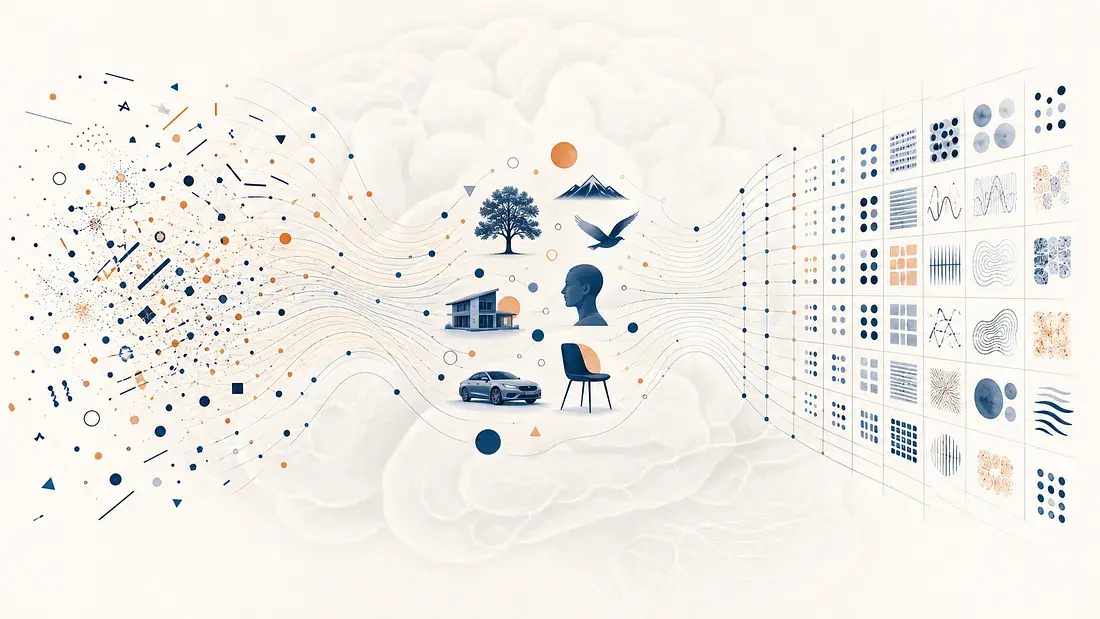
In computer vision systems, a separate stack is assembled for each task: one backbone for classification, another for detection, and a third for segmentation, and then all of this is separately trained, maintained, and scaled.
We are developing TAPe+ML v2, a recognition model that solves any computer vision task with the accuracy of SOTA models, but with a significantly lower number of parameters than the competitors, which have millions or even hundreds of millions of parameters.
This size allows the model to be run not only on server GPUs, but also on mass hardware, from regular CPUs and laptops to embedded devices and single-board computers, where heavy models with hundreds of millions of parameters usually do not fit or require separate optimization.
TAPe converts an image into a structured TAPe feature space: the system first “sees” a frame/image and builds a representation without knowing in advance what response it will require.
The model organizes the work of several simple sub-models on this representation, and the task and dataset determine what the answer will be — detection, classification, segmentation, auto-annotation, search for similar objects, or another scenario.
This allows the same perception architecture and sub-model coordinator to be used for different tasks, without a separate set of backbone models for each task.
Let’s take a closer look.
Disclaimer (for those who are new to TAPe or have forgotten everything)
TAPe is a new way of processing information that we have “borrowed” from the human brain and that emulates its work. We have been able to formally describe, at least partially, how the brain perceives and processes reality: what primary elements it operates with and how it combines them into images, symbols, and meanings.
Detection (COCO)
The practical effect of TAPe+ML v2 is now best seen in object detection. So, TAPe+ML v2 on a specific practical task of ore contamination (see the chapter on the industrial pilot), without a COCO head, on a new backbone based on the client’s data, gives a detection accuracy of 96%, mAP50 — accuracy of 90%, and mAP50–95–85%. That is, TAPe‑detection comes to the level of RF‑DETR in mAP50 with a number of parameters less than 100 thousand against about 127 million for RF‑DETR 2XL.
We applied a sequence of improvements that we do not disclose publicly as know‑how, but their final effects can be fixed on COCO. At different stages, the following values were obtained:
Press enter or click to view image in full size
At the same time, the number of model parameters remained less than 100,000, and the inference time was about 8 ms per image.
As a market benchmark, we also use RF-DETR 2XL, one of the first detection models that exceeded 60% mAP50–95 on COCO while running in real-time (~17.2 ms per image).
For TAPe+ML v2 in the final configuration, we obtain:
Final COCO-detection comparison table
Press enter or click to view image in full size
Classification (ImageNet-1k / COCO oracle)
Press enter or click to view image in full size
As you can see, the classification accuracy of our model is comparable to SOTA, but our model needs less than 100,000 parameters, while DINOv2 needs more than a billion to achieve a decent result. Not to mention DINOv3, which increased the number of parameters by a factor of seven to improve the accuracy by 1.5%, resulting in a staggering 7 billion parameters.
7 billion is 70,000 times more than 100,000. If you think that we will need to increase the number of parameters by at least seven times to catch up with DINOv3, you are mistaken. We achieved an accuracy of 86.6% top-1 on classification.
For us, classification is a benchmark task rather than a standalone product. We did not optimize the model for maximum top-1 accuracy, but rather tested how the TAPe-based recognition core performs in an ImageNet-like setting.
We have not yet attempted to specifically catch up with and surpass SOTA in classification. The goal of TAPe+ML is to achieve robust recognition with a small number of parameters, rather than setting a record for a single metric.
However, if an application requires maximizing classification quality, the architecture allows us to make this adjustment without changing the model’s core. In general, by focusing on recognition, we improve the benchmarks for specific tasks and datasets without making any specific efforts.
ML‑stand: training the head and backbone for a task
In the course of conversations and pilots, we came across the need for our own ML stand, which solves detection problems on COCO with results at the level of strong models and is available to customers. We have made a stand: you can take it “in hand” to run through your scenarios and compare figures and statements with real results.
Get Sergey Kurinov | Comexp’s stories in your inbox
Join Medium for free to get updates from this writer.
Subscribe
Remember me for faster sign in
The stand supports several training modes based on the same TAPe+ML architecture:
The stand clearly separates these modes and explains how they relate to the task and data, which simplifies the dialogue with ML teams on choosing a learning strategy.
Automatic markup (we did it too)
In the classic markup pipeline, the dataset is first marked up manually (often through separate label services and tools), and then the model is trained using this data. In TAPe+ML, there is an auto-markup mode on top of the usual graphical markup interface, where the model takes over the main work. The user uploads a small piece of data, manually marks 10–15 images, and the system immediately (in real time) trains the model on this minimal set, and then it circles the rest of the objects of the corresponding class.; if necessary, the user makes corrections, and the model is further trained on these corrections. All of this works within the same ML stand and TAPe+ML stack: markup, training, and auto‑markup are in the same system, accessible from a browser, and do not require separate software or external label platforms.
Submodel Coordinator: from individual models to a single recognition architecture
Hypothetically, in TAPe+ML, one architecture can be applied everywhere: for Image Classification, Object Detection, Image Segmentation, Clustering & Similarity Search and Feature Extraction and other computer recognition tasks; the model does not depend on a specific dataset, but on the task class. So far, we have tested our performance on the tasks in the field of the first two points — detection and classification, now we are working with other tasks.
We have moved from a monolithic detector to a system of several small models, each of which is responsible for its own part of the task. The TAPe+ML v2 model is essentially a coordinator of several small models.
Depending on the task at hand and the complexity of the dataset (and not just its size), the model automatically expands several submodels to adapt to a specific solution, allowing you to have a flexible system for solving any problem without worrying about the number of parameters or the final result.
Thus, the models in our system are automatically deployed to find the background, to point at an object, to divide objects into prototypes, and so on. Each task works with the simplest “narrow” dataset and an algorithm to solve a large and complex overall problem.
Total: TAPe+ML v2 is a single recognition model. The same architecture first perceives the image and builds its structured representation regardless of the specific task, and then on the same representation, depending on the formulation and dataset, provides an answer in the tasks of detection, classification, segmentation, auto-marking, etc.
Due to this, the same system is used for different recognition tasks without changing the basic architecture.
Industrial Pilot Results
In one of the pilot projects, TAPe+ML was used for the task of finding ore blockages from conveyor belt images.
Initial data
30 images, two classes:
According to the customer, the baseline YOLO 26s model was not up to the task on this dataset.
Steps and results
After the implementation of classification improvements and the new model: about 85% on the original 30 images; on the extended dataset (500 images) — 85.7% with detailed error analysis.
The key difficulties
The final result after the integration of the TAPe coordinator and improvements
For comparison, the YOLO 12s with 9.3 million parameters on the same dataset shows an accuracy of maP50–84%, maP50–95–68%, requires 400 images per class versus <100k parameters for TAPe+ML v2 and up to 50 images per class.
Results for today: in the results on COCO and in the industrial case, TAPe+ML v2 expectedly (for us) showed the level and even higher of strong models, remaining in the class of “less than 100 thousand parameters and units of milliseconds per inference.”
TAPe+ML v2 can be checked/tested independently at the stand.
We are developing TAPe+ML v2, a recognition model that solves any computer vision task with the accuracy of SOTA models, but with a significantly lower number of parameters than the competitors, which have millions or even hundreds of millions of parameters.
This size allows the model to be run not only on server GPUs, but also on mass hardware, from regular CPUs and laptops to embedded devices and single-board computers, where heavy models with hundreds of millions of parameters usually do not fit or require separate optimization.
TAPe converts an image into a structured TAPe feature space: the system first “sees” a frame/image and builds a representation without knowing in advance what response it will require.
The model organizes the work of several simple sub-models on this representation, and the task and dataset determine what the answer will be — detection, classification, segmentation, auto-annotation, search for similar objects, or another scenario.
This allows the same perception architecture and sub-model coordinator to be used for different tasks, without a separate set of backbone models for each task.
Let’s take a closer look.
Disclaimer (for those who are new to TAPe or have forgotten everything)
TAPe is a new way of processing information that we have “borrowed” from the human brain and that emulates its work. We have been able to formally describe, at least partially, how the brain perceives and processes reality: what primary elements it operates with and how it combines them into images, symbols, and meanings.
Detection (COCO)
The practical effect of TAPe+ML v2 is now best seen in object detection. So, TAPe+ML v2 on a specific practical task of ore contamination (see the chapter on the industrial pilot), without a COCO head, on a new backbone based on the client’s data, gives a detection accuracy of 96%, mAP50 — accuracy of 90%, and mAP50–95–85%. That is, TAPe‑detection comes to the level of RF‑DETR in mAP50 with a number of parameters less than 100 thousand against about 127 million for RF‑DETR 2XL.
We applied a sequence of improvements that we do not disclose publicly as know‑how, but their final effects can be fixed on COCO. At different stages, the following values were obtained:
Press enter or click to view image in full size
At the same time, the number of model parameters remained less than 100,000, and the inference time was about 8 ms per image.
As a market benchmark, we also use RF-DETR 2XL, one of the first detection models that exceeded 60% mAP50–95 on COCO while running in real-time (~17.2 ms per image).
For TAPe+ML v2 in the final configuration, we obtain:
- mAP50–95–62.0% vs. ≈60% for RF‑DETR 2XL;
- speed — ~8 ms vs. ~17.2 ms;
- number of parameters — <100k vs. hundreds of millions for large transformer detectors.
Final COCO-detection comparison table
Press enter or click to view image in full size
Classification (ImageNet-1k / COCO oracle)
Press enter or click to view image in full size
As you can see, the classification accuracy of our model is comparable to SOTA, but our model needs less than 100,000 parameters, while DINOv2 needs more than a billion to achieve a decent result. Not to mention DINOv3, which increased the number of parameters by a factor of seven to improve the accuracy by 1.5%, resulting in a staggering 7 billion parameters.
7 billion is 70,000 times more than 100,000. If you think that we will need to increase the number of parameters by at least seven times to catch up with DINOv3, you are mistaken. We achieved an accuracy of 86.6% top-1 on classification.
For us, classification is a benchmark task rather than a standalone product. We did not optimize the model for maximum top-1 accuracy, but rather tested how the TAPe-based recognition core performs in an ImageNet-like setting.
We have not yet attempted to specifically catch up with and surpass SOTA in classification. The goal of TAPe+ML is to achieve robust recognition with a small number of parameters, rather than setting a record for a single metric.
However, if an application requires maximizing classification quality, the architecture allows us to make this adjustment without changing the model’s core. In general, by focusing on recognition, we improve the benchmarks for specific tasks and datasets without making any specific efforts.
ML‑stand: training the head and backbone for a task
In the course of conversations and pilots, we came across the need for our own ML stand, which solves detection problems on COCO with results at the level of strong models and is available to customers. We have made a stand: you can take it “in hand” to run through your scenarios and compare figures and statements with real results.
Get Sergey Kurinov | Comexp’s stories in your inbox
Join Medium for free to get updates from this writer.
Subscribe
Remember me for faster sign in
The stand supports several training modes based on the same TAPe+ML architecture:
- Head-only training. A model pre-trained on COCO is used; the head is retrained for new classes and tasks, while the backbone remains fixed. This mode allows the head to quickly train tasks in domains close to COCO — ordinary “3D objects” in good lighting. In this case, Backbone gives the head descriptions and properties of objects that have been trained from the COCO dataset solution: shapes, textures, colors, etc.
- Learning with backbone adaptation. The same pre-trained model is used, but the retrofitting also affects backbone, adding properties that are necessary for the client’s new task, if the properties from COCO are not enough. This method is best suited for tasks that are NOT similar to the tasks of the COCO dataset — the so–called OOD tasks, Out Of Distribution. Our industrial pilot, whose results we will discuss at the end, used this particular method for training.
- Learning from scratch. Mechanically, this is the same mode with backbone training, but the weights are initialized randomly and the model does not rely on knowledge from COCO. This approach requires more data and time, but it allows you not to drag properties unrelated to the task into the model and build even lighter configurations, that is, save the model with fewer layers, as well as get an even higher accuracy ceiling.
The stand clearly separates these modes and explains how they relate to the task and data, which simplifies the dialogue with ML teams on choosing a learning strategy.
Automatic markup (we did it too)
In the classic markup pipeline, the dataset is first marked up manually (often through separate label services and tools), and then the model is trained using this data. In TAPe+ML, there is an auto-markup mode on top of the usual graphical markup interface, where the model takes over the main work. The user uploads a small piece of data, manually marks 10–15 images, and the system immediately (in real time) trains the model on this minimal set, and then it circles the rest of the objects of the corresponding class.; if necessary, the user makes corrections, and the model is further trained on these corrections. All of this works within the same ML stand and TAPe+ML stack: markup, training, and auto‑markup are in the same system, accessible from a browser, and do not require separate software or external label platforms.
Submodel Coordinator: from individual models to a single recognition architecture
Hypothetically, in TAPe+ML, one architecture can be applied everywhere: for Image Classification, Object Detection, Image Segmentation, Clustering & Similarity Search and Feature Extraction and other computer recognition tasks; the model does not depend on a specific dataset, but on the task class. So far, we have tested our performance on the tasks in the field of the first two points — detection and classification, now we are working with other tasks.
We have moved from a monolithic detector to a system of several small models, each of which is responsible for its own part of the task. The TAPe+ML v2 model is essentially a coordinator of several small models.
Depending on the task at hand and the complexity of the dataset (and not just its size), the model automatically expands several submodels to adapt to a specific solution, allowing you to have a flexible system for solving any problem without worrying about the number of parameters or the final result.
Thus, the models in our system are automatically deployed to find the background, to point at an object, to divide objects into prototypes, and so on. Each task works with the simplest “narrow” dataset and an algorithm to solve a large and complex overall problem.
Total: TAPe+ML v2 is a single recognition model. The same architecture first perceives the image and builds its structured representation regardless of the specific task, and then on the same representation, depending on the formulation and dataset, provides an answer in the tasks of detection, classification, segmentation, auto-marking, etc.
Due to this, the same system is used for different recognition tasks without changing the basic architecture.
Industrial Pilot Results
In one of the pilot projects, TAPe+ML was used for the task of finding ore blockages from conveyor belt images.
Initial data
30 images, two classes:
- Class 1 — extensive objects of permanent shape (12 photos);
- Class 2 — small narrow objects without stable shape and size, where the similarity within the class is more conceptual than visual (18 photos).
According to the customer, the baseline YOLO 26s model was not up to the task on this dataset.
Steps and results
- Checking the basic YOLO 26s: about 28% accuracy on the original dataset.
- Training for TAPe+ML heads only: ≈45%.
- Learning with backbone adaptation: ≈65%.
After the implementation of classification improvements and the new model: about 85% on the original 30 images; on the extended dataset (500 images) — 85.7% with detailed error analysis.
The key difficulties
- are false positives based on Class 1 images, where minimal differences make the task difficult even visually;
- NMS errors in the form of duplicate boxes per Class 2 object;
- about 5% overfit due to low data variability.
The final result after the integration of the TAPe coordinator and improvements
- is the absence of false alarms at the working levels of the confidence threshold;
- fixed NMS — there are no cases of multiple circling of the same object;
- detection accuracy — 96%;
- mAP50–90%;
- mAP50–95 –85%.
- by class: Class 1–100% accuracy, class 2 — ≈90% (89.97%).
For comparison, the YOLO 12s with 9.3 million parameters on the same dataset shows an accuracy of maP50–84%, maP50–95–68%, requires 400 images per class versus <100k parameters for TAPe+ML v2 and up to 50 images per class.
Results for today: in the results on COCO and in the industrial case, TAPe+ML v2 expectedly (for us) showed the level and even higher of strong models, remaining in the class of “less than 100 thousand parameters and units of milliseconds per inference.”
TAPe+ML v2 can be checked/tested independently at the stand.